

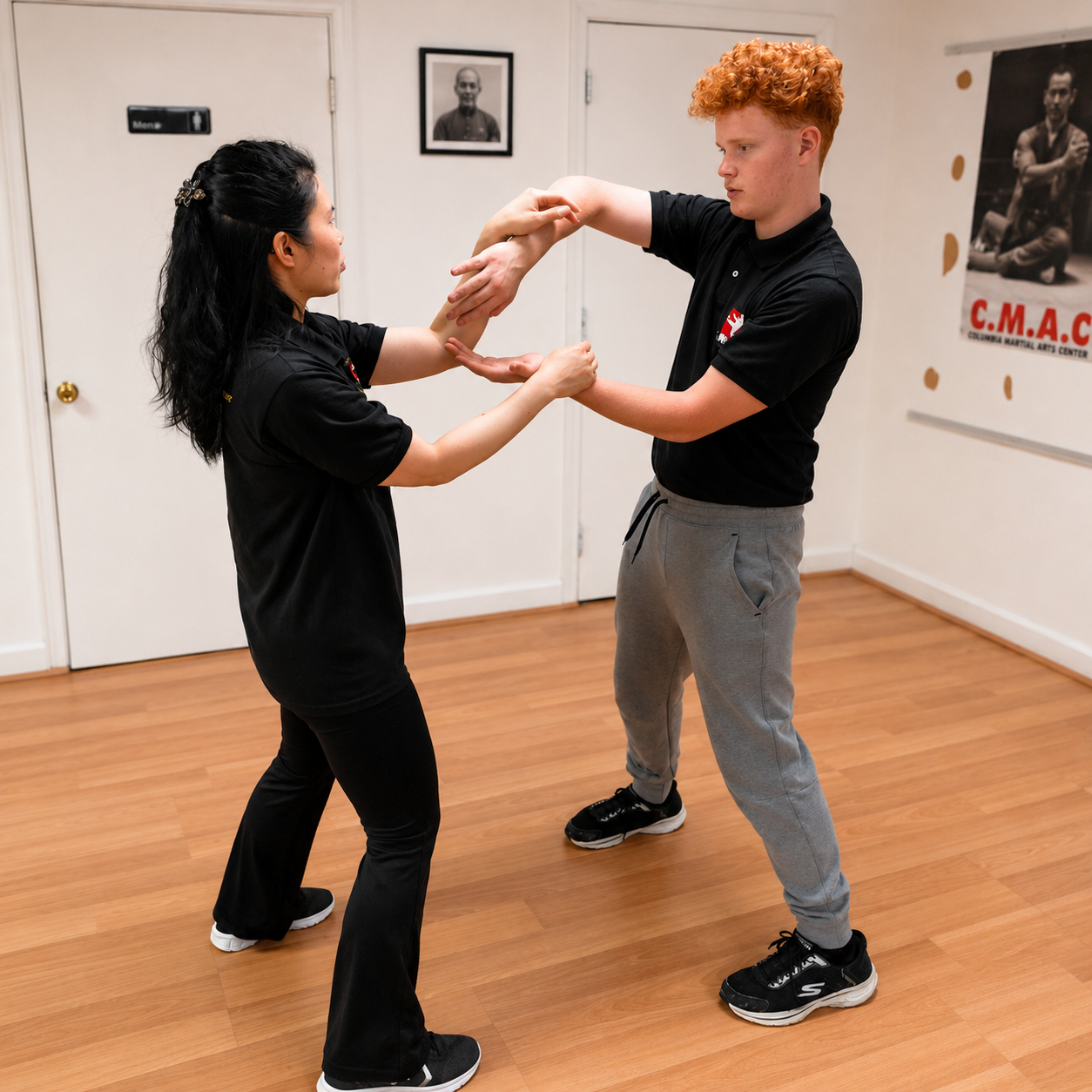
Every martial artist eventually discovers a hard truth:
Knowing techniques is not the same as being able to apply them.
A student may perform a movement perfectly during drills, yet struggle to make it work against a resisting opponent. The difference is not usually a lack of techniques. More often, it is a deficiency in one of three fundamental areas:
Structure. Timing. Adaptation.
These are the three pillars of the DaShan Gung-Fu Training Method (DSGF). They serve as the foundation upon which all functional skill is built.
Pillar One: Structure
Structure is the ability to align the body efficiently to generate, absorb, and redirect force.
Good structure allows a smaller person to maximize leverage. It allows a martial artist to remain balanced while moving, striking, defending, or grappling.
Structure is not simply posture. It is dynamic organization.
A fighter with good structure can:
Generate power efficiently
Maintain balance under pressure
Recover quickly from mistakes
Reduce unnecessary muscular tension
Transfer force through the entire body
Without structure, techniques become dependent upon strength and athleticism. With structure, efficiency replaces effort.
This is why forms, stance work, footwork drills, and positional training remain important. They help build the physical architecture upon which skill is developed.
Pillar Two: Timing
If structure determines how you move, timing determines when you move.
A perfectly executed technique applied at the wrong moment often fails.
A simple technique applied at the right moment often succeeds.
Timing involves:
Distance management
Rhythm recognition
Reading commitment
Interruption
Interception
In the DSGF methodology, students learn to recognize opportunities rather than force techniques.
The goal is not to become faster than everyone else.
The goal is to move at the correct moment.
As many experienced fighters discover, timing often feels like speed to the person on the receiving end.
Pillar Three: Adaptation
Adaptation is the ability to solve problems in real time.
No opponent follows a script.
No fight unfolds exactly as planned.
No technique survives unchanged when faced with resistance.
Adaptation allows a martial artist to:
Adjust to changing circumstances
Flow between ranges
Recover from mistakes
Capitalize on opportunities
Continue functioning under uncertainty
This is where many traditional training methods fall short.
Students may memorize techniques but never develop the ability to modify them when circumstances change.
Adaptation transforms knowledge into skill.
Why the Three Pillars Matter
Most systems organize their curriculum around techniques.
The DSGF methodology organizes training around principles.
Techniques are important, but they are viewed as expressions of deeper concepts.
A punch, takedown, trap, clinch entry, or defensive movement can all be evaluated through the lens of:
Structure
Timing
Adaptation
When these three pillars are present, techniques become functional.
When they are absent, techniques often fail under pressure.
The Goal
The purpose of martial arts training is not to collect techniques.
The purpose is to develop reliable performance.
The DaShan Gung-Fu Training Method uses progressive pressure, resistance, and skill development to cultivate the three pillars that support functional martial ability.
Because in the end, skill is not measured by what you can demonstrate when conditions are perfect.
Skill is measured by what remains when pressure is introduced.
